
- Joined
- Nov 29, 2025
- Messages
- 1,089
- Thread Author
- #1
In computer science, every digital circuit--and, by extension, every intricate algorithm--can be decomposed into a cascade of NAND gates, the elemental primitive underpinning all Boolean logic and thus the edifice of digital computation. Yet in the realms of continuous mathematics, physics, engineering, and machine learning, it was long presumed that an expansive repertoire of operations was indispensable: addition and subtraction, trigonometric functions, logarithms, and their myriad derivatives. Every scientific computing environment and neural architecture appeared obliged to orchestrate this heterogeneous ensemble.
That paradigm has now been upended.
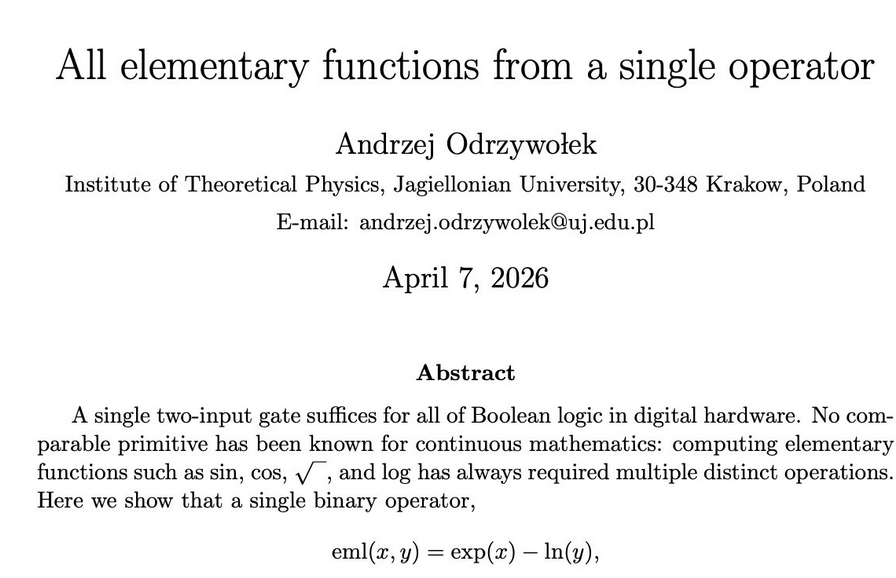
A recent paper demonstrates that the entire corpus of elementary functions can be synthesized from a solitary, enigmatic binary operator: eml(x, y) = exp(x) - ln(y), paired exclusively with the constant 1. From this austere foundation emerge π, the square root, sine and cosine, the arithmetic operations, exponentiation, and virtually every transcendental or algebraic primitive required for scientific computation.
All such expressions reduce to iterative applications of this identical operator, structured as a uniform binary tree. No one had foreseen the existence of such a universal primitive, yet it surfaced through methodical, exhaustive enumeration rather than deliberate invention. Its ramifications for artificial intelligence, however, are profound.
Rather than compelling a model to harmonize disparate mathematical rules in pursuit of novel scientific laws, one may now deploy a singular, homogeneous architecture: a solitary trainable circuit composed of a repeatable node. What we once regarded as the labyrinthine lexicon of the cosmos now reveals itself as the ceaseless recursion of one deceptively simple equation--echoing through the void.
That paradigm has now been upended.
A recent paper demonstrates that the entire corpus of elementary functions can be synthesized from a solitary, enigmatic binary operator: eml(x, y) = exp(x) - ln(y), paired exclusively with the constant 1. From this austere foundation emerge π, the square root, sine and cosine, the arithmetic operations, exponentiation, and virtually every transcendental or algebraic primitive required for scientific computation.
All such expressions reduce to iterative applications of this identical operator, structured as a uniform binary tree. No one had foreseen the existence of such a universal primitive, yet it surfaced through methodical, exhaustive enumeration rather than deliberate invention. Its ramifications for artificial intelligence, however, are profound.
Rather than compelling a model to harmonize disparate mathematical rules in pursuit of novel scientific laws, one may now deploy a singular, homogeneous architecture: a solitary trainable circuit composed of a repeatable node. What we once regarded as the labyrinthine lexicon of the cosmos now reveals itself as the ceaseless recursion of one deceptively simple equation--echoing through the void.