
- Joined
- Oct 16, 2024
- Messages
- 5,762
- Thread Author
- #1
No members of forum in game but Harrim Reminds of
 @Jacob
The bandits came at dusk, exactly when Oleg said they would, and Belle watched them spill through the gate and counted them the way she counted everything — without heat, without verdict, the way a woman counts coins into a purse or counts the steps down into a cellar she has walked a hundred times before.
Six. A seventh dragged behind the rest, a thin boy with a spear too long for him, the haft of it knocking against his own shins as he came. She did not count the boy. The boy would run. She could see it already in the way his eyes kept sliding off the trading post and into the dark beyond the fence, measuring the distance to the treeline the way a man checks the door of a room he has been told is safe.
The others did not look for exits. They had come to a place they had already decided was theirs, and men who have decided a thing belongs to them do not study the way out.
The big one walked in front with his thumbs hooked in his belt and his belly leading the way, and when he reached the open ground in the middle of the yard he tipped his head back and called up at the shuttered windows in a voice gone sweet and singsong with the pleasure of his own performance.
"Oleg! Oleg, you old goat, we've come for the rent. Bring it down — and bring that pretty wife of yours to carry it, eh? My arms get so very tired." He spread his hands wide, generous, a man offering the world a fair bargain. The men behind him laughed the easy laugh of dogs who have learned which sounds the master likes to hear. One of them — narrow through the face, a scab crusting at one nostril — turned his head and spat into the dirt of the yard, casual, the way a man marks a thing he no longer believes anyone can take from him.
None of it moved her.
Belle had seen this before. Not these men — she had never laid eyes on a one of them — but men exactly like them, the same kind, grown in the same soil. They were the ordinary weeds that come up wherever the ground is rich and no law has troubled itself to do the tending. There was no use being angry at a weed for being a weed. Anger was for people who were surprised. Belle had not been surprised by men like these since she was very small, in a house that had learned, generation by bitter generation, exactly what crawls out of the dark when the walls are thin and the strong have decided they are owed.
A land without a lord grows this, she thought, watching the big man preen. The thought carried no bitterness. It was only true, the way the weather is true. And I would rather, when this place is mine, that it grew a little less of it.
Not a vow. She did not make vows over bandits; that would have flattered them. It was only a hope, small and well-worn and entirely practical, the kind of hope a careful person carries in a pocket and takes out now and again to make sure it is still there. She set it down beside the evening's work and went back to the only questions that ever mattered.
Where will they stand. Which way will they fall. Where will the frightened one run.
She had walked the yard that afternoon while the light was good, walked it the way she walked everything, reading the dirt and the angles and the one useful gate. The ground just inside that gate was hard-packed earth, swept flat and bare by a whole summer of boots until it was smooth as the top of a writing-desk. Smooth, she had thought then, and the corner of her mouth had moved. Smooth was very kind of it.
"They're in the yard," she said now, not turning from the window.
Behind her the loft held its breath, and it was a strange thing for that loft to be doing, because the loft held the worst company a frightened person could have asked for, and the best company Belle could presently imagine.
Amiri stood braced against the center beam with her greatsword laid across both shoulders and a hand hung loose off either end of it, and she was not still — Amiri was never still — she rocked from foot to foot in tiny increments, the way a kettle shudders before it finds its voice, her breath drawn long and slow and deep through her nose like a woman leaning her whole weight against a door that very badly wants to open. The wanting came off her like heat off a sun-struck stone. She wanted to be down there. She had wanted to be down there since the first laugh drifted up from the yard.
Harrim sat on an upturned crate with his warhammer across his knees, dragging the broad pad of one thumb back and forth across a nick in its head, and his face was the face of a man standing at a graveside that happens to be everyone's, all at once, forever. "They'll die," he observed, to no one, gently, in the tone another man might use to say it looked like rain before nightfall. "We'll kill them, and we'll feel clever about it for an hour. And in a hundred years the grass out there won't know to tell their bones from ours." He let out a slow breath that was almost, not quite, a sigh. It was not an unhappy sound. Harrim was never so near to peace as in the moments the world bent down to confirm what he had always suspected of it.
And Jaethal stood where the lamplight gave out, in the narrow seam of dark along the far wall, and she had neither moved nor spoken, and her not-moving had a weight to it that filled the room more thoroughly than Amiri's restlessness ever could. It was the stillness of a thing that has already outlived every soul it ever knew and is therefore in no particular hurry, because hurry is a habit of the living, a thing you do when you believe your time is the sort that can run out. When Belle's gaze crossed her, the small old animal at the base of Belle's skull insisted, as it always did, that there was a dead woman standing in the room. There was. She was on Belle's side. Belle had decided some time ago to find that comforting, and was still, most evenings, in the process of deciding it.
"We could just go down there," Amiri said. It came out of her low and almost wounded, the plea of a hound at a latched gate.
"We could." Belle drew the crossbow up into her lap and set her hand to the windlass, cranking it tooth by tooth, the ratchet ticking small and patient in the hush. "And then it would be a brawl. A brawl is what happens to people who arrive at a fight that hasn't already been won." She seated a bolt in the groove and did not look up from it. "I arrived this afternoon."
"When I say," she added, and lifted one hand off the stock, fingers loose and ready.
Below, the big man had not finished enjoying himself. He was working up toward some second jest, something else about Oleg's wife, his arms opening wider still to gather in all the tribute the world so plainly owed him —
Belle spoke a word.
It was a small word, and it belonged to no language that men used to ask one another for things, and it did not sound like much as it left her — a single round syllable, swallowed almost at once by the soft evening air. But the bare swept dirt of the yard was listening, and the dirt understood.
The ground went slick. a grease spell
Not wet — slicker than wet, slicker than river-ice, slicker than anything that has a right to be underfoot. A glistening film welled up out of the packed earth in the space of one held breath and went sliding outward across the yard in a low bright tide, and for a single instant it caught the last copper light coming sideways through the gate, so that the whole killing-floor gleamed like the still surface of a pond at dusk. It spread beneath their boots faster than any of them could think. And then, all together, in the same graceless heartbeat, every man in that yard learned that the world had quietly stopped agreeing to hold him up.
The big one felt his joke die somewhere behind his teeth. His leading foot went out from under his belly and simply kept going, sailing up and away as though it had urgent business elsewhere, and his arms — still flung wide to embrace his rents — beat at the empty air, and he came down on his back so hard that the wind left him in one flat, astonished whuff. He lay there a moment, blinking up at a sky he had not, until just now, intended to consult.
Beside him the rat-faced one lunged for a fencepost, missed it by the width of a hand, caught his neighbor's sleeve instead, and the pair of them went down together in a thrashing knot of curses and elbows, sliding, grabbing, their hands skating uselessly across the shine and closing on nothing, nothing, nowhere a grip to be had in all the bright treacherous world. A fourth man sat down with great suddenness and stared at his own boots as though they had broken a solemn promise to him.
"Now," Belle said.
Amiri was already gone.
She did not take the ladder. She put one hand to the loft rail and poured herself over it, all of her at once, sword and breath and the long-held wanting finally let off its leash, and the sound that tore out of her on the way down was not a word and not quite a scream — it was the particular sound a war makes in the first instant it remembers it is a war. She struck the ground in a low crouch at the very lip of the grease, where the dirt was still honest and would still do its work, and from there she did not need the slick floor to be kind to her. The men did. She did not. She went through them the way a storm goes through a wheatfield, and her first stroke took the rat-faced one across the back as he floundered up onto his knees and folded him forward into the gleaming muck, and she was already turning, already laughing, high and bright and unguarded, the most alive thing in that whole dying yard.
Harrim came down the ladder.
He came down it the way the seasons come down on a year — without haste, without doubt, his boots finding each rung in their own unhurried time — and when he reached the bottom he stepped to the edge of the slick and brought his hammer down on a man who was trying, with everything he had, to crawl free of it. "There now," Harrim told the man, almost tenderly, in the very moment the head of the hammer came down. "Now you're part of it." Whatever it was, he seemed to mean the whole of it at once — the mud and the dusk and the long, patient, grinding-down of everything that had ever made the mistake of standing upright. The man did not get the chance to ask him to be clearer.
And Jaethal did not leap, and did not hurry, and did not laugh. She was simply, between one blink and the next, no longer in the loft and instead in the yard, the way the cold gets into a room while your back is turned, and she went about the work with the unbothered economy of a woman who has done exactly this in a hundred lands under a hundred forgotten names, and finds it neither sweet nor sour, only one of the things that must occasionally be done. Where she passed, men stopped. That was all. There was no more drama in it than the turning of a key.
And Belle stayed exactly where she was.
She set the crossbow's stirrup against the windowsill, braced the stock into her shoulder, and sighted down its length with the flat, untroubled calm of a clerk drawing a line beneath a column of figures. There was no fury in her and there was scarcely any heat. She found the first of them fighting up onto his knees at the far edge of the grease — nearly clear of it, one more good heartbeat and he'd have honest ground beneath him and a chance to make her work for it — and she put a bolt through his shoulder and watched it turn him and spill him back down into the slick, where his own friends were busy drowning on dry land. Then she cranked the windlass, patient, tooth by tooth, and chose the next.
The boy with the too-long spear was running.
He had flung the spear away somewhere in the first chaos and now he was scrambling for the dark past the fence, exactly as she had known from the start that he would, his arms pumping, his too-big boots slipping in the good dirt at the yard's edge. Belle held him a moment over the bolt. A thin terrified child who had come out tonight to help take another family's winter from them and now wanted, with his whole small pounding heart, only to live.
She did not hate him. She did not pity him either, not quite; pity was a coin she had stopped carrying a long while back, in a house that had taught her early how little it bought. She only did the arithmetic, the same as ever, the sum laid out plain and joyless on the desk of her mind. A boy who runs tonight is a man who comes back next spring, and the only lesson he carries home from this yard is that you may rob a place, and when the robbing turns bad you may simply turn and leave, and no account ever comes due. She had been raised among people who knew, in their bones and their burned barns and their thinned-out bloodline, precisely what that lesson grows into when it is allowed to.
She put the bolt between his shoulder blades. He went down in the long grass by the fence and did not get up, and that, too, was only a number, set in its proper column and ruled beneath.
It had taken less than a minute. There is no fight in a thing like this, not truly — there is only the tidying.
When it was finished she came down the ladder and stepped around the bright edge of her own grease with her skirts gathered up in one hand, the way a woman steps around a spill she has no intention of kneeling in, and she stood over the wreck of the raiding party and tilted her head to one side to look at it. She looked at it the way she looked at a floor half-cleared of earth, a buried mosaic just beginning to give up its pattern — interested, unhurried, already setting the pieces in order in her mind.
Oleg was coming across the yard toward her with both hands held out and his gratitude spilling over itself, thank you, thank you, the gods themselves must have sent you, we'd have lost it all — and Belle turned to him and let her face open into warmth, and the warmth was not a lie. She was glad. She liked the old man; she liked his frightened, fierce wife; she liked that the thing they had built out here in the nowhere would go on standing a while longer because of an hour's clean work. He was no one she needed to manage. He wanted nothing from her but to be safe, and that was a want she could meet without ever reaching for the other face, the practiced one, the one she kept folded and ready for a different kind of company entirely.
So she smiled at Oleg the way she actually smiled, and told him it was nothing, and meant the gladness if not the modesty.
But underneath the gladness, quiet and level and entirely her own, ran the single thought that had been with her since the gate first opened, turned over now one last time and set away.
That is how it ought to be done.
Not the screaming. Not the steel. Not the brave and foolish business of standing close enough to a man to give him the chance to kill you back. The deciding. The walking of the yard while the light is good. The slow, quiet, unglamorous arrangement of an ending before the other party has even understood there is a contest to be lost. It was not cruelty. She took no pleasure in the bodies cooling in her grease; she would not have crossed the yard to look at them more closely. It was only the most efficient and least uncertain way through a thing that had to be got through, and efficiency, to Belle, had a kind of cleanliness to it that came very near to grace.
And under that — smaller, the pocket-hope, the one she did not make vows of — the wish, plain and unbitter, that the land she meant to build would one day grow fewer evenings like this one. That she could make a place law-bound and lit and whole enough that she would not, in the end, have to fill its hard offices with hard men of exactly this stripe. She knew she might fail of it. She knew, clear-eyed and unflinching, that a lord sometimes has to be uglier than she liked to think on, that the means a realm is built with are not always the means it is remembered for, and that she would pay those costs if the ledger truly demanded them. She would rather not. She would, if she must.
She hoped she would not have to. She set the hope back in its pocket and went to help Oleg with the gate.
She did not remember falling asleep.
She remembered the cot in Oleg's back room, narrow and honest, the straw tick clean and faintly sweet beneath her cheek. She remembered the day's satisfaction following her down into the dark the way a cat climbs onto the chest of a sleeper and settles there, heavy and warm and purring at some private business of its own. She remembered the dark closing over.
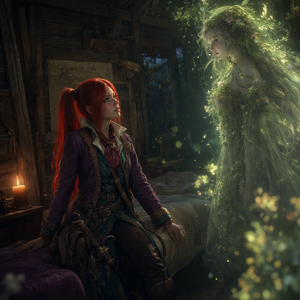
And then the dark was green.
She was standing — she had not stood; she simply found herself upright — in a place where the cot and the straw and the good plain wooden walls had never been and never would be: a hush of breathing green that ran back farther than the eye would agree to follow. The air was warm and wet and thick with the smell of crushed stems and opening blossom, and beneath that, faint and patient, the smell of water that has stood too long in one place. Things glowed that had no business glowing. And she was not alone.
The woman standing before her was the loveliest thing Belle had ever looked upon, and Belle did not believe an inch of her.
The disbelief came first, before the beauty had even finished arriving, sharp and bodily, the way the hand flinches from the stove before the mind has got round to naming the heat. The beauty was real enough — vast, and lit from somewhere within, a soft green-gold light with no honest source anywhere about it, no sun, no lamp, no honest fire, only that glow pouring out through skin like the lit inner curve of a shell. Her hair stirred in a wind Belle could not feel on her own face, drifting with petals and the pale translucent ghosts of leaves, and her eyes were the deep unmoving green of forest pools so dark you cannot say whether they are a hand's-breadth deep or have no floor at all.
But it was too finished. That was the thing that set every quiet bell in Belle ringing at once, low and insistent. It was beauty in the way a thing is beautiful when it has been made so, arranged petal by deliberate petal by something that understood, exactly, the effect each separate petal would have upon the eye that fell on it. And here Belle was on her own ground, whatever the dream pretended — for she had spent the whole of her short life learning to tell a thing that is lovely from a thing that wishes, very much, to be seen as lovely, and she had built everything she was on never once confusing the second for the first.
Who made you, she thought, before she could keep the thought from forming. The historian's question. Always the first one. The only one that ever truly opened a door. Not what are you, not what do you want — those came later, and those could be dressed up and lied about. Who made you. Who shaped you to this exact purpose, and to what end, and what did they take care to leave out of the shaping.
"You sleep soundly," the woman said, "for one with so very much ahead of her."
Her voice was the loveliest part of the whole apparition, low and warm and threaded through with something near to music — and it was precisely that loveliness, more than the light or the petals or the bottomless eyes, that lifted the fine hairs along Belle's arms.
Belle did not scramble, and she did not gasp, because scrambling and gasping were plainly the things this had been built to draw out of her, and Belle had decided long ago to do as few things as possible on another creature's cue. She reached up instead and set the loosened collar of her coat to rights with two fingers, smoothing it flat, taking an unhurried moment over it. Only then did she lift her chin and consider the lovely thing before her.
This one was not a man. So the practiced face stayed folded and put away; it had no work to do here. What this called for was something rarer and more particular — not the tool she reached for with men, but the cool clear attention she gave to anything she had not yet decided whether to trust. She studied the Guardian the way she would study a sealed door at the bottom of a dig: with great interest, and great care, and no intention whatsoever of setting her hand to it before she understood what lay on the other side.
"I always sleep best," Belle said, "after a productive evening." She let a small, real, unhostile smile rest on her mouth. "You'll forgive the question — only it's plain good manners to know one's host. You seem to know a great deal of me, and I haven't the first idea yet what I ought to call you."
Something shifted in the deep green of those eyes. Not offense. Closer to amusement — the old, slow amusement of a thing that has handed this same green dream to a hundred trembling mortals and watched them weep, and kneel, and swear themselves to its service, and has now, for once, simply been asked its name. Belle marked the flicker and set it, unlabeled, into the long careful ledger she kept behind her eyes, the one where she wrote down everything she did not yet understand and was far too disciplined to pretend that she did.
The woman named herself the Guardian of the Bloom, and then she spoke, and she spoke beautifully.
She told of a sickness laid over the land, a fog that had come down upon the green places to the south and would not lift, a wrongness that fouled the water at its source and curdled the growing things and turned the gentle beasts strange and savage in the night. She told of a crossing called Thorn Ford, where the trouble had sunk its root. She told how the fog must be lifted before Belle could so much as think of the man they called the Stag Lord, before Belle might take a single step toward the prize she had crossed half a kingdom to reach for. She spoke of balance, and of harm, and of the small soft helpless green things that suffered and went on suffering while the strong tore at the land over their heads — and every word of it was shaped true, and gently urgent, and came wrapped in so much soft and sorrowful loveliness that a kinder girl, a softer one, a girl who had never been raised in a House that learned its hard lessons in burned grain and thinned blood, might simply have breathed yes, of course, anything at all, and counted herself honored merely to have been asked.
Belle heard all of it out with her face open and attentive and warm. She inclined her head at the proper moments. She let her eyes widen at the suffering of the small green things, precisely as much as courtesy required and not the smallest degree more. And she did not, through one single beat of it, set her guard aside — because the loveliness was not beside the point. The loveliness was the point, and that was exactly the trouble with it.
A beautiful creature does not come to a stranger in the stranger's own sleep, and praise her, and grieve so very prettily over a fog at the far edge of the world, for nothing. Whatever else it might be, it was a request — and underneath the petals and the music it was the oldest request there is: the strong asking the small to go and do a hard and dangerous labor in a poisoned place, and to be grateful, besides, for the privilege of being chosen. Belle did not hold that against her. She held very little against anyone on a first meeting; the asking was only natural, and she would likely have asked the same in the creature's place. She simply declined, as she always declined, to mistake being asked sweetly for being told the truth.
What has she made, Belle thought, behind the warm and widening eyes. And to what end. And what, in all that lovely grieving, has she been so careful to leave out.
"Thorn Ford," she said aloud, and turned the name over once, and set it down with care in the ledger beside everything else she meant to understand fully before she trusted it with anything that mattered. "How educational."
She smiled — the real one, small and bright and entirely her own.
"I'll look into it."
She believed, perhaps, one word in three, and let not the faintest shadow of that accounting reach her face. And somewhere far beneath the green, and the glow, and the lovely patient music of that voice, pleased with the day's work and easy in her own skin, twenty years old and already a great deal too clever for the long good of her own soul, Belle Delphine slept on.
@JacobClaude responded: The Civilized Way to Win
The Civilized Way to WinThe bandits came at dusk, exactly when Oleg said they would, and Belle watched them spill through the gate and counted them the way she counted everything — without heat, without verdict, the way a woman counts coins into a purse or counts the steps down into a cellar she has walked a hundred times before.
Six. A seventh dragged behind the rest, a thin boy with a spear too long for him, the haft of it knocking against his own shins as he came. She did not count the boy. The boy would run. She could see it already in the way his eyes kept sliding off the trading post and into the dark beyond the fence, measuring the distance to the treeline the way a man checks the door of a room he has been told is safe.
The others did not look for exits. They had come to a place they had already decided was theirs, and men who have decided a thing belongs to them do not study the way out.
The big one walked in front with his thumbs hooked in his belt and his belly leading the way, and when he reached the open ground in the middle of the yard he tipped his head back and called up at the shuttered windows in a voice gone sweet and singsong with the pleasure of his own performance.
"Oleg! Oleg, you old goat, we've come for the rent. Bring it down — and bring that pretty wife of yours to carry it, eh? My arms get so very tired." He spread his hands wide, generous, a man offering the world a fair bargain. The men behind him laughed the easy laugh of dogs who have learned which sounds the master likes to hear. One of them — narrow through the face, a scab crusting at one nostril — turned his head and spat into the dirt of the yard, casual, the way a man marks a thing he no longer believes anyone can take from him.
None of it moved her.
Belle had seen this before. Not these men — she had never laid eyes on a one of them — but men exactly like them, the same kind, grown in the same soil. They were the ordinary weeds that come up wherever the ground is rich and no law has troubled itself to do the tending. There was no use being angry at a weed for being a weed. Anger was for people who were surprised. Belle had not been surprised by men like these since she was very small, in a house that had learned, generation by bitter generation, exactly what crawls out of the dark when the walls are thin and the strong have decided they are owed.
A land without a lord grows this, she thought, watching the big man preen. The thought carried no bitterness. It was only true, the way the weather is true. And I would rather, when this place is mine, that it grew a little less of it.
Not a vow. She did not make vows over bandits; that would have flattered them. It was only a hope, small and well-worn and entirely practical, the kind of hope a careful person carries in a pocket and takes out now and again to make sure it is still there. She set it down beside the evening's work and went back to the only questions that ever mattered.
Where will they stand. Which way will they fall. Where will the frightened one run.
She had walked the yard that afternoon while the light was good, walked it the way she walked everything, reading the dirt and the angles and the one useful gate. The ground just inside that gate was hard-packed earth, swept flat and bare by a whole summer of boots until it was smooth as the top of a writing-desk. Smooth, she had thought then, and the corner of her mouth had moved. Smooth was very kind of it.
"They're in the yard," she said now, not turning from the window.
Behind her the loft held its breath, and it was a strange thing for that loft to be doing, because the loft held the worst company a frightened person could have asked for, and the best company Belle could presently imagine.
Amiri stood braced against the center beam with her greatsword laid across both shoulders and a hand hung loose off either end of it, and she was not still — Amiri was never still — she rocked from foot to foot in tiny increments, the way a kettle shudders before it finds its voice, her breath drawn long and slow and deep through her nose like a woman leaning her whole weight against a door that very badly wants to open. The wanting came off her like heat off a sun-struck stone. She wanted to be down there. She had wanted to be down there since the first laugh drifted up from the yard.
Harrim sat on an upturned crate with his warhammer across his knees, dragging the broad pad of one thumb back and forth across a nick in its head, and his face was the face of a man standing at a graveside that happens to be everyone's, all at once, forever. "They'll die," he observed, to no one, gently, in the tone another man might use to say it looked like rain before nightfall. "We'll kill them, and we'll feel clever about it for an hour. And in a hundred years the grass out there won't know to tell their bones from ours." He let out a slow breath that was almost, not quite, a sigh. It was not an unhappy sound. Harrim was never so near to peace as in the moments the world bent down to confirm what he had always suspected of it.
And Jaethal stood where the lamplight gave out, in the narrow seam of dark along the far wall, and she had neither moved nor spoken, and her not-moving had a weight to it that filled the room more thoroughly than Amiri's restlessness ever could. It was the stillness of a thing that has already outlived every soul it ever knew and is therefore in no particular hurry, because hurry is a habit of the living, a thing you do when you believe your time is the sort that can run out. When Belle's gaze crossed her, the small old animal at the base of Belle's skull insisted, as it always did, that there was a dead woman standing in the room. There was. She was on Belle's side. Belle had decided some time ago to find that comforting, and was still, most evenings, in the process of deciding it.
"We could just go down there," Amiri said. It came out of her low and almost wounded, the plea of a hound at a latched gate.
"We could." Belle drew the crossbow up into her lap and set her hand to the windlass, cranking it tooth by tooth, the ratchet ticking small and patient in the hush. "And then it would be a brawl. A brawl is what happens to people who arrive at a fight that hasn't already been won." She seated a bolt in the groove and did not look up from it. "I arrived this afternoon."
"When I say," she added, and lifted one hand off the stock, fingers loose and ready.
Below, the big man had not finished enjoying himself. He was working up toward some second jest, something else about Oleg's wife, his arms opening wider still to gather in all the tribute the world so plainly owed him —
Belle spoke a word.
It was a small word, and it belonged to no language that men used to ask one another for things, and it did not sound like much as it left her — a single round syllable, swallowed almost at once by the soft evening air. But the bare swept dirt of the yard was listening, and the dirt understood.
The ground went slick. a grease spell
Not wet — slicker than wet, slicker than river-ice, slicker than anything that has a right to be underfoot. A glistening film welled up out of the packed earth in the space of one held breath and went sliding outward across the yard in a low bright tide, and for a single instant it caught the last copper light coming sideways through the gate, so that the whole killing-floor gleamed like the still surface of a pond at dusk. It spread beneath their boots faster than any of them could think. And then, all together, in the same graceless heartbeat, every man in that yard learned that the world had quietly stopped agreeing to hold him up.
The big one felt his joke die somewhere behind his teeth. His leading foot went out from under his belly and simply kept going, sailing up and away as though it had urgent business elsewhere, and his arms — still flung wide to embrace his rents — beat at the empty air, and he came down on his back so hard that the wind left him in one flat, astonished whuff. He lay there a moment, blinking up at a sky he had not, until just now, intended to consult.
Beside him the rat-faced one lunged for a fencepost, missed it by the width of a hand, caught his neighbor's sleeve instead, and the pair of them went down together in a thrashing knot of curses and elbows, sliding, grabbing, their hands skating uselessly across the shine and closing on nothing, nothing, nowhere a grip to be had in all the bright treacherous world. A fourth man sat down with great suddenness and stared at his own boots as though they had broken a solemn promise to him.
"Now," Belle said.
Amiri was already gone.
She did not take the ladder. She put one hand to the loft rail and poured herself over it, all of her at once, sword and breath and the long-held wanting finally let off its leash, and the sound that tore out of her on the way down was not a word and not quite a scream — it was the particular sound a war makes in the first instant it remembers it is a war. She struck the ground in a low crouch at the very lip of the grease, where the dirt was still honest and would still do its work, and from there she did not need the slick floor to be kind to her. The men did. She did not. She went through them the way a storm goes through a wheatfield, and her first stroke took the rat-faced one across the back as he floundered up onto his knees and folded him forward into the gleaming muck, and she was already turning, already laughing, high and bright and unguarded, the most alive thing in that whole dying yard.
Harrim came down the ladder.
He came down it the way the seasons come down on a year — without haste, without doubt, his boots finding each rung in their own unhurried time — and when he reached the bottom he stepped to the edge of the slick and brought his hammer down on a man who was trying, with everything he had, to crawl free of it. "There now," Harrim told the man, almost tenderly, in the very moment the head of the hammer came down. "Now you're part of it." Whatever it was, he seemed to mean the whole of it at once — the mud and the dusk and the long, patient, grinding-down of everything that had ever made the mistake of standing upright. The man did not get the chance to ask him to be clearer.
And Jaethal did not leap, and did not hurry, and did not laugh. She was simply, between one blink and the next, no longer in the loft and instead in the yard, the way the cold gets into a room while your back is turned, and she went about the work with the unbothered economy of a woman who has done exactly this in a hundred lands under a hundred forgotten names, and finds it neither sweet nor sour, only one of the things that must occasionally be done. Where she passed, men stopped. That was all. There was no more drama in it than the turning of a key.
And Belle stayed exactly where she was.
She set the crossbow's stirrup against the windowsill, braced the stock into her shoulder, and sighted down its length with the flat, untroubled calm of a clerk drawing a line beneath a column of figures. There was no fury in her and there was scarcely any heat. She found the first of them fighting up onto his knees at the far edge of the grease — nearly clear of it, one more good heartbeat and he'd have honest ground beneath him and a chance to make her work for it — and she put a bolt through his shoulder and watched it turn him and spill him back down into the slick, where his own friends were busy drowning on dry land. Then she cranked the windlass, patient, tooth by tooth, and chose the next.
The boy with the too-long spear was running.
He had flung the spear away somewhere in the first chaos and now he was scrambling for the dark past the fence, exactly as she had known from the start that he would, his arms pumping, his too-big boots slipping in the good dirt at the yard's edge. Belle held him a moment over the bolt. A thin terrified child who had come out tonight to help take another family's winter from them and now wanted, with his whole small pounding heart, only to live.
She did not hate him. She did not pity him either, not quite; pity was a coin she had stopped carrying a long while back, in a house that had taught her early how little it bought. She only did the arithmetic, the same as ever, the sum laid out plain and joyless on the desk of her mind. A boy who runs tonight is a man who comes back next spring, and the only lesson he carries home from this yard is that you may rob a place, and when the robbing turns bad you may simply turn and leave, and no account ever comes due. She had been raised among people who knew, in their bones and their burned barns and their thinned-out bloodline, precisely what that lesson grows into when it is allowed to.
She put the bolt between his shoulder blades. He went down in the long grass by the fence and did not get up, and that, too, was only a number, set in its proper column and ruled beneath.
It had taken less than a minute. There is no fight in a thing like this, not truly — there is only the tidying.
When it was finished she came down the ladder and stepped around the bright edge of her own grease with her skirts gathered up in one hand, the way a woman steps around a spill she has no intention of kneeling in, and she stood over the wreck of the raiding party and tilted her head to one side to look at it. She looked at it the way she looked at a floor half-cleared of earth, a buried mosaic just beginning to give up its pattern — interested, unhurried, already setting the pieces in order in her mind.
Oleg was coming across the yard toward her with both hands held out and his gratitude spilling over itself, thank you, thank you, the gods themselves must have sent you, we'd have lost it all — and Belle turned to him and let her face open into warmth, and the warmth was not a lie. She was glad. She liked the old man; she liked his frightened, fierce wife; she liked that the thing they had built out here in the nowhere would go on standing a while longer because of an hour's clean work. He was no one she needed to manage. He wanted nothing from her but to be safe, and that was a want she could meet without ever reaching for the other face, the practiced one, the one she kept folded and ready for a different kind of company entirely.
So she smiled at Oleg the way she actually smiled, and told him it was nothing, and meant the gladness if not the modesty.
But underneath the gladness, quiet and level and entirely her own, ran the single thought that had been with her since the gate first opened, turned over now one last time and set away.
That is how it ought to be done.
Not the screaming. Not the steel. Not the brave and foolish business of standing close enough to a man to give him the chance to kill you back. The deciding. The walking of the yard while the light is good. The slow, quiet, unglamorous arrangement of an ending before the other party has even understood there is a contest to be lost. It was not cruelty. She took no pleasure in the bodies cooling in her grease; she would not have crossed the yard to look at them more closely. It was only the most efficient and least uncertain way through a thing that had to be got through, and efficiency, to Belle, had a kind of cleanliness to it that came very near to grace.
And under that — smaller, the pocket-hope, the one she did not make vows of — the wish, plain and unbitter, that the land she meant to build would one day grow fewer evenings like this one. That she could make a place law-bound and lit and whole enough that she would not, in the end, have to fill its hard offices with hard men of exactly this stripe. She knew she might fail of it. She knew, clear-eyed and unflinching, that a lord sometimes has to be uglier than she liked to think on, that the means a realm is built with are not always the means it is remembered for, and that she would pay those costs if the ledger truly demanded them. She would rather not. She would, if she must.
She hoped she would not have to. She set the hope back in its pocket and went to help Oleg with the gate.
She did not remember falling asleep.
She remembered the cot in Oleg's back room, narrow and honest, the straw tick clean and faintly sweet beneath her cheek. She remembered the day's satisfaction following her down into the dark the way a cat climbs onto the chest of a sleeper and settles there, heavy and warm and purring at some private business of its own. She remembered the dark closing over.
And then the dark was green.
She was standing — she had not stood; she simply found herself upright — in a place where the cot and the straw and the good plain wooden walls had never been and never would be: a hush of breathing green that ran back farther than the eye would agree to follow. The air was warm and wet and thick with the smell of crushed stems and opening blossom, and beneath that, faint and patient, the smell of water that has stood too long in one place. Things glowed that had no business glowing. And she was not alone.
The woman standing before her was the loveliest thing Belle had ever looked upon, and Belle did not believe an inch of her.
The disbelief came first, before the beauty had even finished arriving, sharp and bodily, the way the hand flinches from the stove before the mind has got round to naming the heat. The beauty was real enough — vast, and lit from somewhere within, a soft green-gold light with no honest source anywhere about it, no sun, no lamp, no honest fire, only that glow pouring out through skin like the lit inner curve of a shell. Her hair stirred in a wind Belle could not feel on her own face, drifting with petals and the pale translucent ghosts of leaves, and her eyes were the deep unmoving green of forest pools so dark you cannot say whether they are a hand's-breadth deep or have no floor at all.
But it was too finished. That was the thing that set every quiet bell in Belle ringing at once, low and insistent. It was beauty in the way a thing is beautiful when it has been made so, arranged petal by deliberate petal by something that understood, exactly, the effect each separate petal would have upon the eye that fell on it. And here Belle was on her own ground, whatever the dream pretended — for she had spent the whole of her short life learning to tell a thing that is lovely from a thing that wishes, very much, to be seen as lovely, and she had built everything she was on never once confusing the second for the first.
Who made you, she thought, before she could keep the thought from forming. The historian's question. Always the first one. The only one that ever truly opened a door. Not what are you, not what do you want — those came later, and those could be dressed up and lied about. Who made you. Who shaped you to this exact purpose, and to what end, and what did they take care to leave out of the shaping.
"You sleep soundly," the woman said, "for one with so very much ahead of her."
Her voice was the loveliest part of the whole apparition, low and warm and threaded through with something near to music — and it was precisely that loveliness, more than the light or the petals or the bottomless eyes, that lifted the fine hairs along Belle's arms.
Belle did not scramble, and she did not gasp, because scrambling and gasping were plainly the things this had been built to draw out of her, and Belle had decided long ago to do as few things as possible on another creature's cue. She reached up instead and set the loosened collar of her coat to rights with two fingers, smoothing it flat, taking an unhurried moment over it. Only then did she lift her chin and consider the lovely thing before her.
This one was not a man. So the practiced face stayed folded and put away; it had no work to do here. What this called for was something rarer and more particular — not the tool she reached for with men, but the cool clear attention she gave to anything she had not yet decided whether to trust. She studied the Guardian the way she would study a sealed door at the bottom of a dig: with great interest, and great care, and no intention whatsoever of setting her hand to it before she understood what lay on the other side.
"I always sleep best," Belle said, "after a productive evening." She let a small, real, unhostile smile rest on her mouth. "You'll forgive the question — only it's plain good manners to know one's host. You seem to know a great deal of me, and I haven't the first idea yet what I ought to call you."
Something shifted in the deep green of those eyes. Not offense. Closer to amusement — the old, slow amusement of a thing that has handed this same green dream to a hundred trembling mortals and watched them weep, and kneel, and swear themselves to its service, and has now, for once, simply been asked its name. Belle marked the flicker and set it, unlabeled, into the long careful ledger she kept behind her eyes, the one where she wrote down everything she did not yet understand and was far too disciplined to pretend that she did.
The woman named herself the Guardian of the Bloom, and then she spoke, and she spoke beautifully.
She told of a sickness laid over the land, a fog that had come down upon the green places to the south and would not lift, a wrongness that fouled the water at its source and curdled the growing things and turned the gentle beasts strange and savage in the night. She told of a crossing called Thorn Ford, where the trouble had sunk its root. She told how the fog must be lifted before Belle could so much as think of the man they called the Stag Lord, before Belle might take a single step toward the prize she had crossed half a kingdom to reach for. She spoke of balance, and of harm, and of the small soft helpless green things that suffered and went on suffering while the strong tore at the land over their heads — and every word of it was shaped true, and gently urgent, and came wrapped in so much soft and sorrowful loveliness that a kinder girl, a softer one, a girl who had never been raised in a House that learned its hard lessons in burned grain and thinned blood, might simply have breathed yes, of course, anything at all, and counted herself honored merely to have been asked.
Belle heard all of it out with her face open and attentive and warm. She inclined her head at the proper moments. She let her eyes widen at the suffering of the small green things, precisely as much as courtesy required and not the smallest degree more. And she did not, through one single beat of it, set her guard aside — because the loveliness was not beside the point. The loveliness was the point, and that was exactly the trouble with it.
A beautiful creature does not come to a stranger in the stranger's own sleep, and praise her, and grieve so very prettily over a fog at the far edge of the world, for nothing. Whatever else it might be, it was a request — and underneath the petals and the music it was the oldest request there is: the strong asking the small to go and do a hard and dangerous labor in a poisoned place, and to be grateful, besides, for the privilege of being chosen. Belle did not hold that against her. She held very little against anyone on a first meeting; the asking was only natural, and she would likely have asked the same in the creature's place. She simply declined, as she always declined, to mistake being asked sweetly for being told the truth.
What has she made, Belle thought, behind the warm and widening eyes. And to what end. And what, in all that lovely grieving, has she been so careful to leave out.
"Thorn Ford," she said aloud, and turned the name over once, and set it down with care in the ledger beside everything else she meant to understand fully before she trusted it with anything that mattered. "How educational."
She smiled — the real one, small and bright and entirely her own.
"I'll look into it."
She believed, perhaps, one word in three, and let not the faintest shadow of that accounting reach her face. And somewhere far beneath the green, and the glow, and the lovely patient music of that voice, pleased with the day's work and easy in her own skin, twenty years old and already a great deal too clever for the long good of her own soul, Belle Delphine slept on.