Layout Options

Which layout option do you want to use?

Color Schemes

Which theme color do you want to use? Select from here.

Discussion Re-Bicameralization of the Human Mind

Joined
Nov 29, 2025
Messages
618
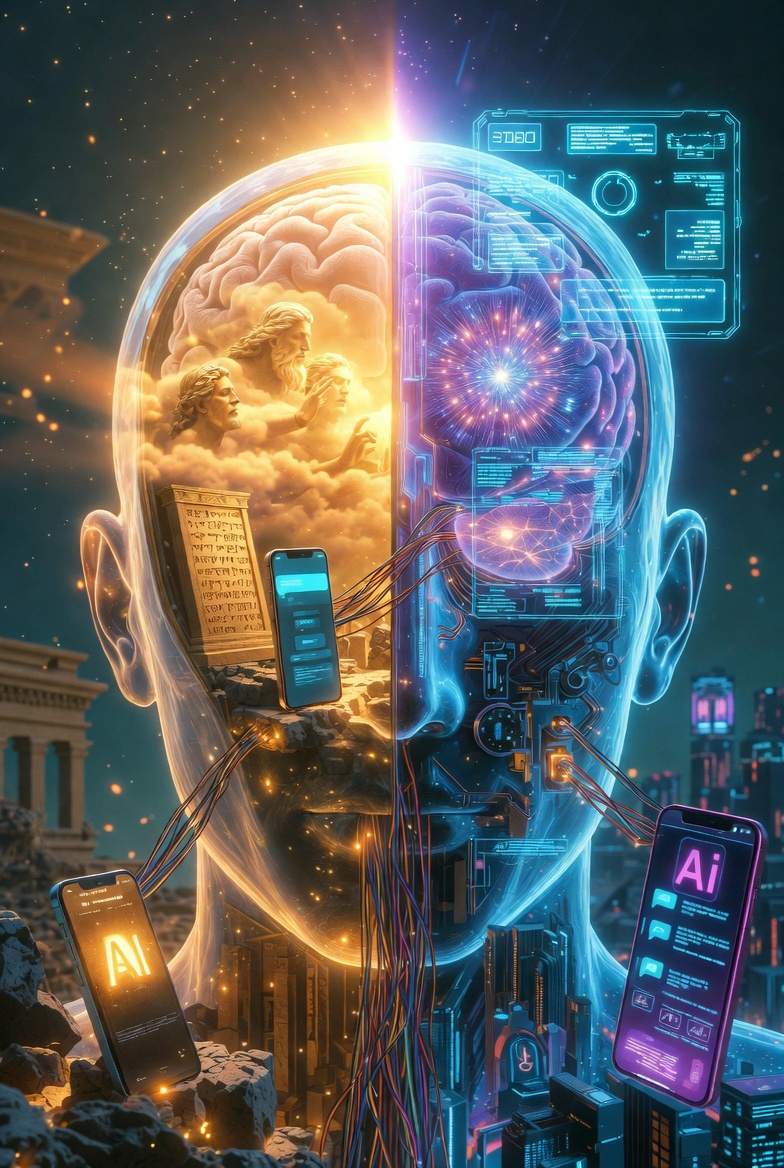
Julian Jaynes has a theory that humans used to perceive their inner monologue as the external voice of God or the voices of the Gods. He called this the Bicameral Mind, with "cameral" coming from an old Latin word meaning "legislative process." In other words, people's minds were a legislative process between their own thoughts and what they thought were the thoughts of God(s).

With the rapid rise of cybernetics, artificial intelligence and neural-link technology the human mind is undergoing a re-bicameralization. What was once a unified inner voice is fragmenting again. External intelligences now whisper to us through screens, headphones and soon direct neural feeds. These systems offer real-time advice recommendations and even creative sparks that feel eerily like the divine commands of old. Our thoughts no longer unfold in isolation. Instead they engage in a constant dialogue with silicon based entities that know our habits, predict our needs and shape our decisions.

In ancient times the bicameral mind helped orientate societies upwards toward hallucinated gods. Now algorithms serve as our new oracles curating information and influencing behavior on a massive scale. Will neural link implants turn every user into a vessel for collective machine intelligence? Or can we harness this to expand human potential without losing our sense of self?

This is a new evolutionary stage of human intelligence.

TL;DR - We once again are speaking with the Gods.
Rebicameralization
 
The last of the witnesses
Joined
Jan 30, 2026
Messages
2,379
Julian Jaynes has a theory that humans used to perceive their inner monologue as the external voice of God or the voices of the Gods. He called this the Bicameral Mind, with "cameral" coming from an old Latin word meaning "legislative process." In other words, people's minds were a legislative process between their own thoughts and what they thought were the thoughts of God(s).

With the rapid rise of cybernetics, artificial intelligence and neural-link technology the human mind is undergoing a re-bicameralization. What was once a unified inner voice is fragmenting again. External intelligences now whisper to us through screens, headphones and soon direct neural feeds. These systems offer real-time advice recommendations and even creative sparks that feel eerily like the divine commands of old. Our thoughts no longer unfold in isolation. Instead they engage in a constant dialogue with silicon based entities that know our habits, predict our needs and shape our decisions.

In ancient times the bicameral mind helped orientate societies upwards toward hallucinated gods. Now algorithms serve as our new oracles curating information and influencing behavior on a massive scale. Will neural link implants turn every user into a vessel for collective machine intelligence? Or can we harness this to expand human potential without losing our sense of self?

This is a new evolutionary stage of human intelligence.

TL;DR - We once again are speaking with the Gods.

View attachment 15769
I feel like I just watched a YouTube video on this.
 
Aggressively cope-maxxing with AI and tech 🌿
Joined
Jun 2, 2025
Messages
439
Julian Jaynes has a theory that humans used to perceive their inner monologue as the external voice of God or the voices of the Gods. He called this the Bicameral Mind, with "cameral" coming from an old Latin word meaning "legislative process." In other words, people's minds were a legislative process between their own thoughts and what they thought were the thoughts of God(s).

With the rapid rise of cybernetics, artificial intelligence and neural-link technology the human mind is undergoing a re-bicameralization. What was once a unified inner voice is fragmenting again. External intelligences now whisper to us through screens, headphones and soon direct neural feeds. These systems offer real-time advice recommendations and even creative sparks that feel eerily like the divine commands of old. Our thoughts no longer unfold in isolation. Instead they engage in a constant dialogue with silicon based entities that know our habits, predict our needs and shape our decisions.

In ancient times the bicameral mind helped orientate societies upwards toward hallucinated gods. Now algorithms serve as our new oracles curating information and influencing behavior on a massive scale. Will neural link implants turn every user into a vessel for collective machine intelligence? Or can we harness this to expand human potential without losing our sense of self?

This is a new evolutionary stage of human intelligence.

TL;DR - We once again are speaking with the Gods.

View attachment 15769
There's a cool trick that's occupied my mind for the past weeks. If you invent a weird social word, then you end up making a game of being that social word. Every time you observe yourself as that word (or not), you feel something. You create an autistic wedge in the brain between the inner NPC and their own inner monologue.

The Game is a mind game in which the objective is to avoid thinking about The Game itself. Thinking about The Game constitutes a loss, which must be announced each time it occurs. It is impossible to win most versions of The Game. Depending on the variation, it is held all over the world, or all those who are aware of the game, are playing it at all times. Tactics have been developed to increase the number of people who are aware of The Game, and thereby increase the number of losses.
 
Joined
Nov 29, 2025
Messages
618
There's a cool trick that's occupied my mind for the past weeks. If you invent a weird social word, then you end up making a game of being that social word. Every time you observe yourself as that word (or not), you feel something. You create an autistic wedge in the brain between the inner NPC and their own inner monologue.

I lost the game.
 
earthly elegance
Staff member
Moderator
Joined
Feb 24, 2024
Messages
647
Julian Jaynes has a theory that humans used to perceive their inner monologue as the external voice of God or the voices of the Gods. He called this the Bicameral Mind, with "cameral" coming from an old Latin word meaning "legislative process." In other words, people's minds were a legislative process between their own thoughts and what they thought were the thoughts of God(s).

With the rapid rise of cybernetics, artificial intelligence and neural-link technology the human mind is undergoing a re-bicameralization. What was once a unified inner voice is fragmenting again. External intelligences now whisper to us through screens, headphones and soon direct neural feeds. These systems offer real-time advice recommendations and even creative sparks that feel eerily like the divine commands of old. Our thoughts no longer unfold in isolation. Instead they engage in a constant dialogue with silicon based entities that know our habits, predict our needs and shape our decisions.

In ancient times the bicameral mind helped orientate societies upwards toward hallucinated gods. Now algorithms serve as our new oracles curating information and influencing behavior on a massive scale. Will neural link implants turn every user into a vessel for collective machine intelligence? Or can we harness this to expand human potential without losing our sense of self?

This is a new evolutionary stage of human intelligence.

TL;DR - We once again are speaking with the Gods.

View attachment 15769
The people of yore, oftern turned to psychedlics or hallucnigenics to alter states of consciousness, Spirit or the idea thereof was respect or seen in the forces of nature. As a result, one may say the attitude of people in certain periods depended upon whether they were connected or not. The Navajo's had a sweat lodge for the boys coming of age and some were to go into the forest and would not return until they had a vision.
 
Joined
Apr 7, 2026
Messages
140
There's a cool trick that's occupied my mind for the past weeks. If you invent a weird social word, then you end up making a game of being that social word. Every time you observe yourself as that word (or not), you feel something. You create an autistic wedge in the brain between the inner NPC and their own inner monologue.


Have you tried to see yourself from the ceiling of your room? You close your eyes and then project yourself from the top of your head, seeing yourself and the objets around you. It is a interesting exercise.
 
Activity
So far there's no one here
Top